

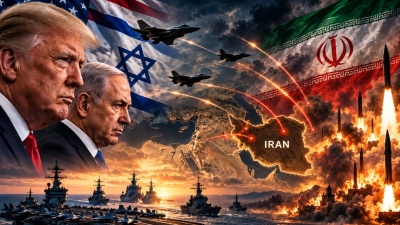
The conflict between Iran and the US appears to be moving on a trajectory of uncontrolled escalation, with Tehran considering, according to an analysis by Foreign Affairs, a new war doctrine that goes far beyond missile strikes: from closing the Strait of Hormuz and suffocating global energy markets to attacks on US bases, ground operations in neighboring states, and even strikes on critical infrastructure.
The most nightmarish scenario described is a coordinated regional offensive aimed at making the US presence in the Middle East so costly that Washington will be forced to retreat.
As the analysis notes, the US launched bombings against Iran on February 28 aimed at destroying the country's nuclear and missile program. However, according to Foreign Affairs, American objectives were not achieved to the degree sought by Washington.
Indeed, the analysis argues that Iran may today be stronger than it was when the war began.
Iran closes the Strait of Hormuz and pressures the global economy
According to Foreign Affairs, Iran managed to bring the Strait of Hormuz under its control and shut it down, causing a sharp spike in energy prices.
At the same time, according to the analysis, the Iranian armed forces proved that even under intense bombing they can continue to inflict damage on US military bases.
Simultaneously, domestic support for the war within the US, which was already limited, has declined, while international outrage against Washington has grown.
As a result, according to Foreign Affairs, it is hardly surprising that several analysts estimate that Tehran will persist in the same direction in the coming year.
Tehran no longer trusts Washington
If Iran still feared Washington, the US administration might have been able to pressure it into making concessions.
However, according to Foreign Affairs, this assessment does not reflect the atmosphere prevailing today in the Iranian capital.
The war has hardened the Iranian leadership, which has lost friends and family members. Iranian officials now view February 28 in a manner analogous to how Israelis view the attack by Hamas on October 7, 2023.
Trust toward American negotiators was already limited. Now, according to the analysis, it has virtually disappeared.
New strategy: Continuous pressure and escalation
According to Foreign Affairs, Iran has adopted a strategy toward the US based on escalation and continuous offensive action.
This does not merely mean that it will continue the same policy, nor that it will pursue a compromise with Washington.
On the contrary, Tehran may proceed with new actions targeting the economies of regional allies of the US, global energy markets, US military infrastructure in the Middle East, and also, according to the analysis, American and Israeli officials.
Foreign Affairs further estimates that Iran may attempt ground operations against neighboring countries, even aiming to seize US bases in Gulf Arab states.
Objective: Making the American presence excessively costly
The new approach may not lead the US to retreat.
However, even if neither side manages to prevail and they ultimately reach an agreement, Foreign Affairs assesses that peace will hardly be lasting.
Tehran believes that Washington will regroup and eventually restart the war.
The Iranian government, according to the analysis, is determined to respond forcefully to any American provocation and may even attack without such a provocation having preceded.
The primary objective of Iran, according to Foreign Affairs, will be to make the US presence in the Middle East so costly that Washington will have no choice but to withdraw a large portion of its forces, accept Tehran's control over the Strait of Hormuz, and recognize the Islamic Republic as a permanent regional power.
Preemptive strikes against US bases
Foreign Affairs reports that the Iranian government has already carried out preemptive attacks.
In July, for example, it attacked bases in Jordan used by the US military, claiming that those specific facilities were being used to prepare attacks against Iran.
Three American soldiers were killed in the attack.
The new strategy, according to the analysis, does not aim solely at psychologically deterring Washington.
It is also designed to systematically weaken the American military and intelligence infrastructure in the Middle East.
Iran's «lawnmower»
At this point, Foreign Affairs compares Iran's strategy to the Israeli strategy known as «mowing the grass» («lawnmower»).
This is an approach in which repeated, limited-scale attacks are conducted, aimed at gradually weakening the adversary's capabilities between larger rounds of conflict.
Iran, according to the analysis, hopes in this way to degrade the ability of the US to protect its allies and forces from future Iranian attacks.
Thus, it is estimated that Washington's incentive to remain in the region will also diminish.
Tehran considers that its strategy is paying off
Iranian officials appear, according to Foreign Affairs, satisfied with the results of their tactics.
They consider that the rapid and extensive escalation across the entire region forced Israel and the US to curtail their attacks against civilian infrastructure in Iran and contributed to lowering the intensity of the war.
In the past, certain Iranian officials considered that peaceful coexistence with the US might be possible.
Now, according to the analysis, virtually no one in Iran shares this view.
Tehran has reached the conclusion that the US will never be a reliable partner and considers that American policy is characterized by successive betrayals.
The 2015 agreement and the new attacks
The US withdrew from the 2015 nuclear agreement just three years after it was reached.
Subsequently, according to the Iranian viewpoint presented by Foreign Affairs, Washington attacked Iran in June 2025 and in February 2026, while the two sides were in negotiations.
From Tehran's perspective, the US is responsible for the collapse of the latest peace effort, namely the «memorandum of understanding» signed by the two countries in June, as it attempted to establish a new maritime route through the Strait of Hormuz.
Over time, however, the global economy may develop alternative export routes for existing routes in the Gulf, with the result that closing the Strait of Hormuz will become less effective as a leverage tool.
Trump's electoral «window»
Iranian officials believe that Trump is currently constrained because he wants the Republicans to prevail in the upcoming midterm elections and because expanding the war with Iran is deeply unpopular inside the US.
After the elections, however, the American president will not be obliged to worry to the same extent about his popularity.
Tehran may hope for a Democratic victory in 2028, but does not believe that such an outcome would necessarily be positive for Iran.
Joe Biden had promised during his election campaign that he would return to the 2015 agreement, yet after entering the White House he attempted without success to extract concessions from Iran, utilizing the sanctions from the «maximum pressure» policy of Trump's first term.
The next American administration may also conclude that it faces a structural conflict with Iran and continue the pressure policy.
A more moderate president might be a greater challenge
Indeed, Foreign Affairs assesses that a more moderate American president may pose a greater challenge for Iran.
The reason is that such a president could repair Washington's international relations and mobilize European, Asian, and regional allies in the Middle East to participate more actively in a pressure campaign against Tehran.
Consequently, according to the analysis, Iran will hardly remain idle.
Tehran can already ramp up pressure on Washington in many different ways.
Oil and natural gas: The energy weapon
One of the primary scenarios is the complete shutdown of oil and natural gas exports from the Persian Gulf.
By closing the Strait of Hormuz, Iran has already halted a large part of this commercial activity.
However, certain Gulf states are still able to access the Indian Ocean either directly or via the Red Sea.
To cut off this access, Iran could, according to Foreign Affairs, directly attack oil installations and ports in those countries.
Concurrently, it could coordinate with its allies, the Houthis in Yemen, to close the Red Sea and threaten ships transiting the area with bombardment.
The Houthis and the Red Sea
The Houthis have attained, according to the analysis, a more favorable position to close the Red Sea anew, having seized more territory from forces backed by Saudi Arabia in Yemen.
Saudi Arabia, in reaction, temporarily suspended the operation of a pipeline used to transport oil from the Persian Gulf to the Red Sea.
New strikes on US bases and cyberattacks
Iran could also intensify attacks against its direct adversaries.
These could include more drone and missile attacks against US military bases.
At the same time, Tehran may conduct more cyberattacks against American civilian infrastructure.
Foreign Affairs reports that US officials believe something similar occurred in July, when parts of the water infrastructure in Minnesota were temporarily knocked offline.
If Iran is attacked again, it could target civilian infrastructure in the Persian Gulf with greater intensity, including water desalination plants, in a development that could render certain regions uninhabitable.
Even assassinations of officials on the table
Foreign Affairs even considers the possibility that Iran might attempt to assassinate American and Israeli officials.
According to American officials, Tehran attempted in 2024 to recruit an individual to assassinate Trump, but the plot was immediately thwarted by US law enforcement authorities.
Iran has denied those allegations.
However, according to the analysis, Tehran possesses various options, including covert operations or utilizing its network of regional allies to target specific individuals.
No compromises on escalation
Iran may conclude that it can achieve deterrence simply by mirroring actions that Israel and the US have carried out against it.
However, if this method does not prove sufficient, Iranian officials, according to Foreign Affairs, will not hesitate to use new tactics.
One of these could be the disruption of global communications.
The Strait of Hormuz is not merely a critical energy artery. It also hosts vital telecommunications infrastructure, including submarine Internet cables connecting Europe to South Asia.
Tehran could, according to the analysis, attempt to sever these cables using combat divers, unmanned underwater vehicles, or vessels dragging their anchors along the seabed.
The scenario of ground operations
Going even further, Iran may attempt to seize neighboring territories.
Iranian analysts have noted that Israel, after October 7, seized territories in Gaza, Lebanon, and Syria, arguing that the action was necessary for its security.
The same analysts maintain that Iran too should attempt to create buffer zones.
Tehran is more likely to seriously consider such a move if it believes that a US ground offensive is imminent.
Following reports by US officials regarding the possibility of an attack and seizure of Kharg Island, Iran's primary oil export terminal, some Iranian analysts and lawmakers proposed attacking Bahrain and Kuwait and seizing US bases in the region.
Tehran could present such moves not as territorial expansionism, but as defensive actions aimed at denying forward operating bases to its adversaries.
The front with Azerbaijan
Iran could apply the same logic to its northern borders.
Azerbaijan and Israel are close partners, and many Iranian officials, citing claims that Azerbaijan has rejected, accuse it of allowing Israel to use its territory as an operational base against Iran.
Azerbaijan denies the allegations.
However, it represents an important oil supplier to Israel, and according to Foreign Affairs, this may be enough to lead Tehran to attempt the capture of Nakhchivan, the exclave of Azerbaijan that borders Iran.
At a minimum, Tehran could strike the energy infrastructure of Azerbaijan.
The Kurdish front in Iraq
Similarly, Iran could move into the Kurdish region of Iraq, which Tehran considers a base for anti-regime forces.
During the first weeks of the war, US officials had considered arming Kurdish groups and pushing them into ground operations.
If Tehran believes that the US is seeking to create a land corridor from Israel to Iran (a corridor that would necessarily pass through the Kurdish areas of Iraq), it could conduct a preemptive ground attack.
In such a scenario, Iran could request that Iraqi militias also attack Syria, which would form part of such a corridor.
Concurrently, it could move against Syria if the country's new leadership created conditions for military operations against Hezbollah, Iran's ally in Lebanon.
Even the Houthis could, according to the scenario examined by Foreign Affairs, be called upon to enter the territory of Saudi Arabia.
The nuclear card remains on the table
The Iranian government still officially maintains that it does not intend to manufacture a nuclear weapon.
However, according to Foreign Affairs, if Iranian officials conclude that nothing else can halt US attacks, they may conclude that acquiring nuclear weapons now represents a «responsible» choice.
If Israel and Washington carry out new strikes, destroy critical infrastructure, or deploy ground forces, it is likely, according to the analysis, to further reinforce the resolve of the Islamic Republic.
The Iranian government could then climb yet another rung on the escalation ladder.
However, Foreign Affairs emphasizes that Tehran is not necessarily bound to move immediately to the highest possible level.
The major conflict may not be over
If Washington perceives this dynamic, it might attempt, in the face of new Iranian provocations, to achieve a ceasefire or «freeze» the conflict in some way.
In the long term, however, according to Foreign Affairs, even this is unlikely to prove sufficient.
The Islamic Republic is entirely clear regarding its primary objective: the withdrawal of all US forces from the Middle East.
And, according to the analysis, it is prepared to remain in a state of war for an indefinite period in order to achieve this goal.
The extreme scenario: Massive attack across the entire region
Foreign Affairs even considers the possibility that Iran may carry out a major offensive operation without an immediate attack or threat having preceded it, choosing the moment when Washington will be caught off guard.
In such a scenario, Iran and its allies could unleash a coordinated and simultaneous ground assault against various US allies and US bases in the region.
The assault could be accompanied by a wide-scale bombing campaign, including strikes against US naval forces.
The objective, according to the analysis, would be to exert such pressure on the US military in a short timeframe that it would be forced to retreat.
«Iran does not seek war» but prepares for escalation
Mohsen Rezaei, Secretary of the Supreme National Security Council of Iran, stated in an interview in August that the country will act within a «reasonable and rational» framework.
As he argued, this course of action must be such that «the world can walk alongside us» and «our own people» understand that Iran «does not truly seek war.»
However, Foreign Affairs arrives at a particularly grim assessment regarding the trajectory Tehran may follow:
Iran is more prepared than ever to expand the scope of its targets and attack a far broader array of targets until the US retreats.
www.bankingnews.gr











Σχόλια αναγνωστών